Wales

Using the traditional names and boundaries suggested by The Association of British Counties, Wales (Cymru) has the following 13 counties: Anglesey (Sir Fon), Brecknockshire (Sir Frycheiniog), Caernarfonshire (Sir Gaernarfon), Carmarthenshire (Sir Gaerfyrddin), Cardiganshire (Ceredigion), Denbighshire (Sir Ddinbych), Flintshire (Sir Fflint), Glamorgan (Morgannwg), Merioneth (Meirionnydd), Monmouthshire (Sir Fynwy), Montgomeryshire (Sir Drefaldwyn), Pembrokeshire (Sir Benfro), Radnorshire (Sir Faesyfed).
Across the centuries, the boundaries of the regions of Wales have varied considerably. Initially this was the result of battles for territory between the different tribes. More recently, it has been more for administrative & bureaucratic convenience. The map on the left shows the situation around the 12th century. The map on the right shows how it was at the end of the 20th century.

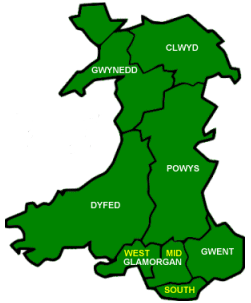
For the map on the right, in rough terms (with a little exchange between some of the counties): - Gwynedd covers Anglesey, Carnarvonshire & Merioneth - Clwyd covers Denbighshire & Flintshire - Powys covers Montgomeryshire, Radnorshire & Breconshire - Dyfed covers Cardiganshire, Carmarthenshire & Pembrokeshire - Glamorgan has been split into 3 administrative regions (West, Mid & South) - Gwent covers Monmouthshire.
More information on Wales will be added in due course.
...

 Using the traditional names and boundaries suggested by The Association of British Counties, England has the following 39 counties:
Bedfordshire, Berkshire, Buckinghamshire, Cambridgeshire, Cheshire, Cornwall, Cumberland, Derbyshire, Devon, Dorset, Durham, Essex, Gloucestershire, Hampshire, Herefordshire, Hertfordshire, Huntingdonshire, Kent, Lancashire, Leicestershire, Lincolnshire, Middlesex, Norfolk, Northamptonshire, Northumberland, Nottinghamshire, Oxfordshire, Rutland, Shropshire, Somerset, Staffordshire, Suffolk, Surrey, Sussex, Warwickshire, Westmorland, Wiltshire, Worcestershire, Yorkshire.
Using the traditional names and boundaries suggested by The Association of British Counties, England has the following 39 counties:
Bedfordshire, Berkshire, Buckinghamshire, Cambridgeshire, Cheshire, Cornwall, Cumberland, Derbyshire, Devon, Dorset, Durham, Essex, Gloucestershire, Hampshire, Herefordshire, Hertfordshire, Huntingdonshire, Kent, Lancashire, Leicestershire, Lincolnshire, Middlesex, Norfolk, Northamptonshire, Northumberland, Nottinghamshire, Oxfordshire, Rutland, Shropshire, Somerset, Staffordshire, Suffolk, Surrey, Sussex, Warwickshire, Westmorland, Wiltshire, Worcestershire, Yorkshire.
 England is sometimes talked about as if it was divided into different Regions, each comprising various counties. There is no formally accepted method of division but the following are not uncommon, although it should be noted that some of them have been 'stretched' to ensure that all of the counties are included somewhere:
» North-West : Cumberland, Lancashire, Westmorland
» North-East : Durham, Northumberland, Yorkshire
» West Midlands : Cheshire, Gloucestershire, Herefordshire, Shropshire, Staffordshire, Warwickshire, Worcestershire with Bedfordshire
» East Midlands : Derbyshire, Huntingdonshire, Leicestershire, Lincolnshire, Northamptonshire, Nottinghamshire, Rutland
» East Anglia : Norfolk, Suffolk with Cambridgeshire, Essex
» Thames Valley ** : Berkshire, Buckinghamshire, Oxfordshire with Wiltshire
» South-West...
England is sometimes talked about as if it was divided into different Regions, each comprising various counties. There is no formally accepted method of division but the following are not uncommon, although it should be noted that some of them have been 'stretched' to ensure that all of the counties are included somewhere:
» North-West : Cumberland, Lancashire, Westmorland
» North-East : Durham, Northumberland, Yorkshire
» West Midlands : Cheshire, Gloucestershire, Herefordshire, Shropshire, Staffordshire, Warwickshire, Worcestershire with Bedfordshire
» East Midlands : Derbyshire, Huntingdonshire, Leicestershire, Lincolnshire, Northamptonshire, Nottinghamshire, Rutland
» East Anglia : Norfolk, Suffolk with Cambridgeshire, Essex
» Thames Valley ** : Berkshire, Buckinghamshire, Oxfordshire with Wiltshire
» South-West...  GREAT BRITAIN comprises