Scotland

The Scots are proud of their country. See A History of Scotland for some reasons why this can be justified even though much of the past was not as glamorous as some may think it was.
Although its land acreage is relatively small, Scotland has a large coastline whilst, thanks to the Orkney & Shetland Islands, its maritime territory is quite significant. Lerwick, the main town of the Shetland Isles, is closer to Bergen in Norway than it is to Edinburgh.
Using the traditional names and boundaries suggested by The Association of British Counties, Scotland has the following 34 counties: Aberdeenshire, Angus/Forfarshire, Argyllshire, Ayrshire, Banffshire, Berwickshire, Buteshire, Cromartyshire, Caithness, Clackmannanshire, Dumfriesshire, Dunbartonshire/Dumbartonshire, East Lothian/Haddingtonshire, Fife, Inverness-shire, Kincardineshire, Kinross-shire, Kirkcudbrightshire, Lanarkshire, Midlothian/Edinburghshire, Morayshire, Nairnshire, Orkney, Peeblesshire, Perthshire, Renfrewshire, Ross-shire, Roxburghshire, Selkirkshire, Shetland, Stirlingshire, Sutherland, West Lothian/Linlithgowshire, Wigtownshire.
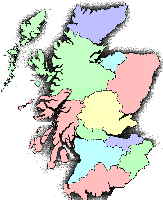
There is no single truly traditional and always-accepted method of dividing Scotland into smaller regions, groups of counties, but the following is not uncommon: » Borders : Berwickshire, Roxburghshire, Selkirkshire. » Dumfries and Galloway : Dumfriesshire, Kirkcudbrightshire, Wigtownshire. » Lothian : East Lothian, Midlothian, West Lothian. » Central-South : Ayrshire, Lanarkshire, Peeblesshire, Renfrewshire. » Central-North : Dunbartonshire/Dumbartonshire, Stirlingshire. » Argyll and Bute : Argyllshire, Buteshire. » Perthshire, Tayside and Fife : Clackmannanshire, Fife, Kinross-shire, Perthshire. » Grampian : Aberdeenshire, Angus/Forfarshire, Banffshire, Kincardineshire. » Moray and Nairn : Morayshire, Nairnshire. » The Highlands and The Western Islands : Inverness-shire, Cromartyshire, Ross-shire. » Sutherland and Caithness : Sutherland, Caithness. » The Northern Isles (not shown...

 Using the traditional names and boundaries suggested by The Association of British Counties, England has the following 39 counties:
Bedfordshire, Berkshire, Buckinghamshire, Cambridgeshire, Cheshire, Cornwall, Cumberland, Derbyshire, Devon, Dorset, Durham, Essex, Gloucestershire, Hampshire, Herefordshire, Hertfordshire, Huntingdonshire, Kent, Lancashire, Leicestershire, Lincolnshire, Middlesex, Norfolk, Northamptonshire, Northumberland, Nottinghamshire, Oxfordshire, Rutland, Shropshire, Somerset, Staffordshire, Suffolk, Surrey, Sussex, Warwickshire, Westmorland, Wiltshire, Worcestershire, Yorkshire.
Using the traditional names and boundaries suggested by The Association of British Counties, England has the following 39 counties:
Bedfordshire, Berkshire, Buckinghamshire, Cambridgeshire, Cheshire, Cornwall, Cumberland, Derbyshire, Devon, Dorset, Durham, Essex, Gloucestershire, Hampshire, Herefordshire, Hertfordshire, Huntingdonshire, Kent, Lancashire, Leicestershire, Lincolnshire, Middlesex, Norfolk, Northamptonshire, Northumberland, Nottinghamshire, Oxfordshire, Rutland, Shropshire, Somerset, Staffordshire, Suffolk, Surrey, Sussex, Warwickshire, Westmorland, Wiltshire, Worcestershire, Yorkshire.
 England is sometimes talked about as if it was divided into different Regions, each comprising various counties. There is no formally accepted method of division but the following are not uncommon, although it should be noted that some of them have been 'stretched' to ensure that all of the counties are included somewhere:
» North-West : Cumberland, Lancashire, Westmorland
» North-East : Durham, Northumberland, Yorkshire
» West Midlands : Cheshire, Gloucestershire, Herefordshire, Shropshire, Staffordshire, Warwickshire, Worcestershire with Bedfordshire
» East Midlands : Derbyshire, Huntingdonshire, Leicestershire, Lincolnshire, Northamptonshire, Nottinghamshire, Rutland
» East Anglia : Norfolk, Suffolk with Cambridgeshire, Essex
» Thames Valley ** : Berkshire, Buckinghamshire, Oxfordshire with Wiltshire
» South-West...
England is sometimes talked about as if it was divided into different Regions, each comprising various counties. There is no formally accepted method of division but the following are not uncommon, although it should be noted that some of them have been 'stretched' to ensure that all of the counties are included somewhere:
» North-West : Cumberland, Lancashire, Westmorland
» North-East : Durham, Northumberland, Yorkshire
» West Midlands : Cheshire, Gloucestershire, Herefordshire, Shropshire, Staffordshire, Warwickshire, Worcestershire with Bedfordshire
» East Midlands : Derbyshire, Huntingdonshire, Leicestershire, Lincolnshire, Northamptonshire, Nottinghamshire, Rutland
» East Anglia : Norfolk, Suffolk with Cambridgeshire, Essex
» Thames Valley ** : Berkshire, Buckinghamshire, Oxfordshire with Wiltshire
» South-West...  GREAT BRITAIN comprises